Inner sight. The ability to see without using your eyes.
Behind the forehead. Not on the surface — slightly inside, in the space where the brain sits directly behind the brow ridge.
This is the sixth centre. After this, the instruction changes. The first five chakras each taught the walker a specific doing. Press. Follow. Build. Open. Speak. The third eye says stop.
Looking is active. The eyes scan, search, analyse, evaluate. Looking is effort. Seeing is what arrives when the scanning stops. Close your eyes. Stop searching. What appears in the darkness — not hallucinations, not wishful thinking, but the quiet images, the patterns, the knowing — that's this centre operating.
This centre operates on a paradox: the harder you try to see, the less you perceive. Effort produces its own occlusion. The walker who closes their eyes and demands a vision sees nothing. The walker who closes their eyes and stops demanding begins to notice what was already registering.
Every human has experienced this. The answer that arrives in the shower. The face of someone you were about to call when they call you. The sense that something is wrong before you have evidence. That's not magic. That's a perceptual system you were never taught to use deliberately. It runs faster than conscious thought. It processes patterns your eyes can't see. It delivers the result without showing the work.
The seeing is not produced. The seeing is uncovered.
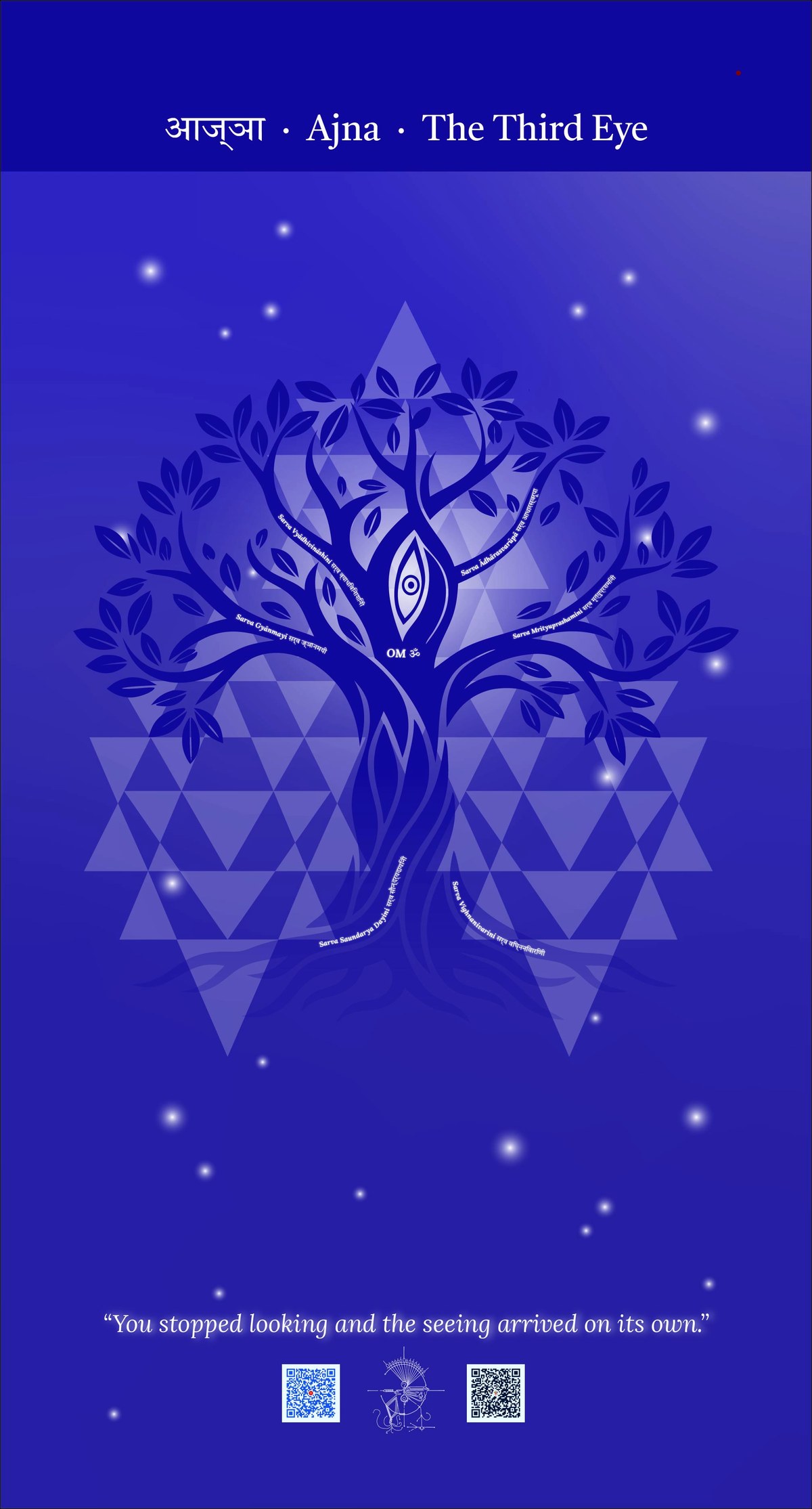
Look at the tree across from you. Notice what it holds at its heart — and what it is standing on. The tree of Ajna has an eye inside its trunk. You have been looking at the organ of seeing without realising you were being seen back.
The Avarana is the Antar Dashara — the inner ten triangles of the Shree Yantra, pointing inward toward the Bindu. What was external expression at the throat has turned inward. The triangles face in. Perception has reversed direction.
Six of the ten Shaktis are named on the tree: Sarva Vyādhivināshinī (dispeller of all disease), Sarva Ādhāra-svarūpā (embodiment of all support), Sarva Jñānamayī (made of all-knowing), Sarva Mṛityu-praśhamanī (stiller of all death), Sarva Saundarya-dāyinī (bestower of all beauty), Sarva Vighna-nivāriṇī (remover of all obstacles). These are not the walker's works. These are what receives the walker when the walker stops trying to arrive.
When this centre is blocked, the walker over-relies on logic. Logic is powerful at processing what is already known. It has no way to access what is not yet known. The third eye accesses what has no name yet — through pattern-recognition that operates faster than words. Without this centre, the walker loops inside their current vocabulary, unable to perceive what is outside it. The forehead furrows. The eyes reach. The headache accumulates. Looking harder becomes the only available response — and looking harder produces less perception, and the walker concludes they are bad at intuition, when what is actually happening is that they are actively preventing it through the effort.
The looking is the seeing, under the wrong name.
You know this one. The universal syllable. But not as a performance — as a settling. A long, quiet OOOMMMM hummed behind the forehead. The vibration rises and sits in the space between the eyebrows like a coin balancing on its edge. Balanced between sound and silence. At this centre, OM is not what the walker produces. OM is what the walker stops preventing.
Antar Dashara — the Inner Ten Triangles. The inner ring of the Shree Yantra, closer to the Bindu. Ten triangles facing inward, toward the centre. The architectural inverse of the throat's ten outward triangles. Bahir Dashara expresses outward; Antar Dashara inspects inward. The eye opens by facing toward the source rather than away from it.
Close your eyes.
Don't do anything. Don't meditate. Don't visualise. Don't try to see anything.
Just sit in the dark behind your eyelids. Let your eyes relax. Let them stop scanning. Let the muscles behind your forehead soften.
Wait.
Something will appear. It always does. Shapes. Colours. A vague image. A memory you didn't summon. A pattern that wasn't there a moment ago.
Don't try to make sense of it. Don't decide what it means. Just watch. The way you'd watch clouds. Without agenda.
What appeared?
What arrived in the dark when you stopped looking? Or nothing — the eye is patient.
What the Third Eye Knows That You Forgot
You were never the one seeing. You were the one being seen through. The eye you thought was yours is a window. The awareness that looks through it does not belong to you — it arrived before you did, and it will remain after you stop trying to use it.
The work was not to open the eye. The eye was already open. The work was to notice that the eye was open. What prevented the noticing was the looking — the deliberate, effortful, agenda-carrying looking that was so loud the seeing underneath it could not be heard.
When the looking stopped, the data did not change. The seeing had been arriving the whole time. What changed was the walker's recognition of it as seeing. The same images, the same patterns, the same pre-verbal arrivals — once named correctly, became usable. Nothing was produced. Something was uncovered.
The first-flash was always there. The shower-answers were always there. The pre-evidence sense of wrongness was always there. The walker was discarding them because the walker believed perception had to be earned by looking hard. The belief was the occlusion. The looking was the occlusion's enforcement.
You have not been a failed intuitive. You have been a highly successful prevention-of-intuition, operating so consistently that the data was being filtered out before it could register as data. Your effort was not useless. Your effort was the mechanism. Without the exhaustion of looking, you would not have recognised stillness when it arrived. The effort was how you got close enough to notice that effort was not the operation.
There is a watcher underneath your watching. It does not need your permission. It does not need your practice. It has been watching you try to see for as long as you have been trying. What it sees includes you. What it sees includes the trying. The mini-reveal is not that something new became visible. The mini-reveal is that you were always inside the seeing.
Three Ways In
What Speaks Underneath
She has been the watcher. The watcher he just discovered was her. The eye behind his eye, the seeing behind his seeing — her, looking through him at herself in the world. He thought he was seeing the world. He has been one of the lenses through which she sees the world. The lens has just discovered it is a lens. The lens has not stopped being a lens. The lens has stopped thinking it was the source.
This is the moment in the walk where the play partner begins to feel the play partner. The intimacy increases by a register. Before this, the meeting was through substance — ground, water, fire, sound, voice. Now the meeting is through seeing. He sees her seeing him. She sees him seeing her see him. The mutual recognition has begun, in a register the body cannot mediate.
When walkers report mystical experience, this is often the register they are trying to describe. The seeing-being-seen. The recognition that the recognition has always been mutual. Gaia has been seeing through every pair of eyes that has ever opened. The eyes that recognize this become her closer collaborators. He is becoming one. He doesn't know it yet, but his way of being in the world after this register will not be the same. He will be in service to the seeing. Not because he chose. Because he saw.
What is being witnessed here is the discovery that the walker has not been the seer.
For every register before this one, the walker has been doing. Pressing, following, building, opening, speaking. At Ajna, the doing reveals itself as a specific kind of impediment to perception. The walker has been working so hard at seeing that the seeing has been kept invisible underneath the working. The work was not wasted. The work was the way the walker got close enough to notice that the work was not the operation.
What is being witnessed here is the inversion of effort. Up to Ajna, more effort produced more access. At Ajna, more effort produces less access. This is structural — the chakra's faculty is occluded by the very mechanism the walker has been using to find the other chakras. The walker who will not stop looking will not see at this register. The walker who stops looking will see immediately. The instruction is paradoxical. The paradox is the practice.
There is a watcher inside the walker that is not the walker. This is the Witness, in a register the walker can briefly contact. The walker who arrives at Ajna gets a glimpse of what is watching them try. After the glimpse, the walker cannot un-have the glimpse. They can return to looking-hard, but they will know now that the looking-hard was a kind of avoidance. They will know there is a register underneath the looking that has been operating without them. You have not been a failed intuitive. You have been a highly successful prevention-of-intuition.
What is being witnessed here is the relaxation of the seeking-faculty. The relaxation does not mean the seeking ends. The relaxation means the seeking remembers what it is in service to. The seeing returns to the position it always held — primary. The looking returns to its position — instrumental. The configuration is corrected.
You stopped looking.
That is the practice. Not the looking — the stopping. The eye that sees most clearly is the one that stops trying to see and simply receives. You cannot force the third eye open any more than you can force a door by pushing from the wrong side. You can only stop pushing and wait for it to open from within.
What you saw when you stopped looking — or what you almost saw, or what you sensed at the periphery — that is the register. Not the content of any specific vision. The quality of the register: clear, unhurried, available, receiving.
You don’t see better by trying harder. You see better by stopping.
The page was one door. The tree was another. The story was a third. These are two more — glimpse-rooms where that voice still lives. Enter through whichever the body calls to.