Can I receive?
— or, at the register of practice — what if the walls were doors?
This center governs one question — not who do I love the way an inventory answers, but the rawer version. Can you receive what has been arriving in your chest since before you had the word for it? The root grounded you. The sacral moved you. The solar plexus built you. Now the heart asks the question that renders all of that legible: what was all that building for?
The Sanskrit name means unstruck sound. A sound that plays without anything being hit. No hammer on a bell. No finger on a string. A frequency that needs no trigger because it was never started. It was always playing. Before you were born. Before you had a name. Before anyone told you what love was supposed to look like. You have heard it. Walking down a street. Looking at a stranger on a train. Watching light move through a window in the late afternoon and your eyes fill and you don't know why. That's Anahata. The unstruck sound arriving in a body that finally got quiet enough to hear it.
Anahata is not an emotion-center only. It is a relational center — the first one you will meet in this sequence. The three chakras below this one are your body meeting impersonal substance. Earth. Water. Fire. Anahata is the first center that involves other. Not a specific other. The capacity for other. The register at which your interior meets what is not-you.
It is also the midpoint of everything. Three centers below — earth, water, fire. Three centers above — space, light, radiance. Anahata is the place where the bottom three stop being separate from the top three. The hinge. Not a stage. Unlike the Energy Chakras before it — which are sequential — Anahata is the middle from which the whole sequence becomes visible in both directions.
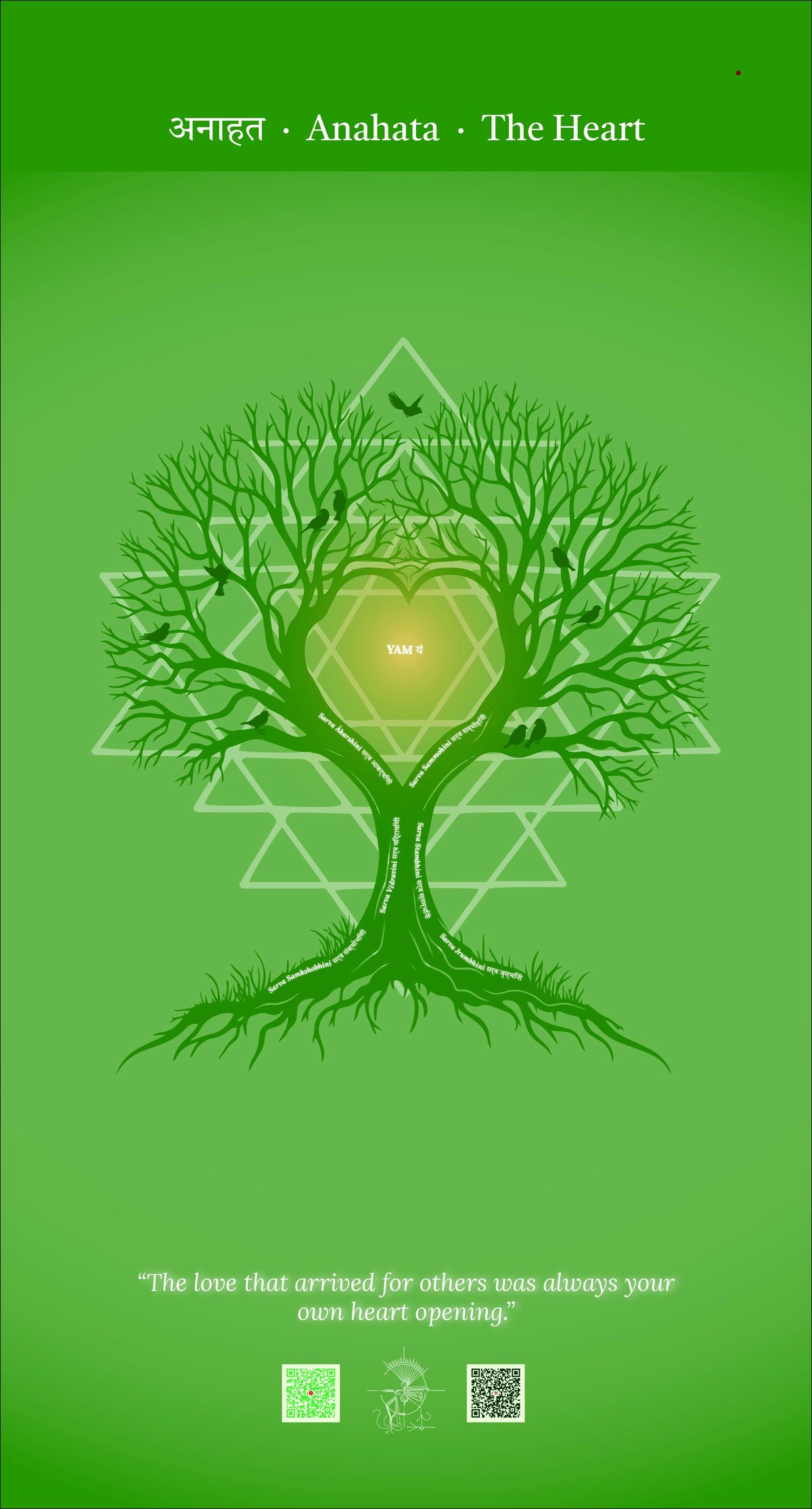
Look at the tree across from you. More space than branch. Open enough that the light moves through. Open enough that the birds lifting from the branches are not pushing off — they are being held by what they are lifting from. The tree didn't open by effort. It grew open enough that the holding-on stopped being required.
Every wall you have built around your heart was a reasonable response to something that hurt you. Every one. A specific moment. A specific face. A specific sentence someone said that landed in your chest like a stone and stayed. You built the wall the same day the stone arrived. Sometimes the same hour. That was intelligence. Your system protecting something it knew was too important to let happen again.
The practice is not tearing down what you built. The practice is noticing that the cut healed years ago. And the wall is still there. And the wall is so familiar now that you forgot it was a wall. You think it is you. You think the protection IS your personality — the person who gives warmth to everyone but access to no one. That is the wall wearing your face.
The door is what happens when you realize: the thing you were protecting yourself from already happened. It already came. It already landed. And you survived. You are here, reading this page with your hand on your chest. The walls can be doors now. Not all at once. Not to everyone. One door. One person. One moment where you choose to let what your heart is broadcasting actually reach the person across from you.
There are forces in this center that have names older than your language. Six of them, woven into the tree across from you — you can read them on the roots and the trunk. Samkshobhini agitates everything toward love. Vidrāvinī melts all resistance. Ākarshini pulls everything toward the center. Sammohini enchants — the love that made no logical sense. Stambhini holds you in the opening. Jrumbhini expands you past where you thought the edges were. They are operating right now. In you. Whether or not you look closely enough to find their names in the branches.
The deepest teaching Anahata carries is this: the love was always in you. Every person you have loved has been a mirror your own heart used to recognize its own face. The specific features of that face matter — the beloved is not arbitrary, the beloved is the particular angle of light the heart needed to see something in itself — but the light was always yours. This is not a consolation. Grief is still grief. The beloved is still beloved. But something important shifts when you recognize the source correctly. You stop being at the mercy of love. You are no longer in a position where someone can walk away and take your heart with them. The heart never left your chest. You only thought it did.
And — the wildest consequence of this recognition: the heart cannot be broken. It can only be opened further. Every loss, every rejection, every door slammed — did not break the heart. Broke open something the heart was ready to let go of. Every time you have said my heart is broken, what has actually happened is the heart has opened one more chamber you did not know was there.
An open, expanding tone. Hum it in the center of your chest. Feel the sternum vibrate. YAM opens. You will feel your chest soften before the hum is finished. The attack is gentle — 0.03 seconds — almost no onset. The decay is long — 3.5 seconds. Love lingers. The tone is calibrated to crystal — the warmest-toned and longest-sustained of any awakening sound in the sequence. The frequency itself is the teaching.
Chaturdasha Trikona — the Fourteen Triangles. Seven pointing upward, seven pointing downward. Interlocking. The first interlocking of ascending and descending forces in the Shree Yantra. Before Anahata, all avaranas pointed one direction — Muladhara's square earth, Svadhisthana's sixteen-petal water, Manipura's eight-petal fire. Anahata is the first avarana where opposing geometries meet. Love as the intersection. What rises and what descends are not in opposition. They create each other.
Put your hand on your chest.
Feel your heartbeat through your palm. That's it. Don't change it. Don't deepen it. Don't try to slow it down or time it with your breathing. Just feel it. Two minutes.
The heart responds to attention the way a plant responds to water. You don't have to do anything else. You don't have to think loving thoughts. You don't have to summon gratitude. You don't have to visualize light or warmth or anyone you miss. Attention is the water. The heart is already the plant.
What you will feel, after maybe a minute, is the place under your palm softening. Not a metaphor. A specific sensation — like a fist you did not know you were making is unclenching. That unclenching is Anahata recognizing that you noticed it.
The unstruck sound plays louder when it is listened for. It does not get louder. Your ability to hear it improves.
You don't open the heart. You get quiet enough that the opening becomes audible.
What the Heart Knows That You Forgot
You thought the love came from the other person.
You thought that is why it hurt so much when they left, when they disappointed you, when the relationship ended. You thought they took the love with them when they went. That is why grief felt like having something amputated — because you were convinced a crucial piece of you had left the building with them.
But notice what is still happening right now, with them gone. You can still feel the love. You can still warm your chest by remembering them. You can still ache in the exact shape of their absence. The love is still here. They are not here, but the love is. Which means the love was never in them.
The love was always in you, finding a shape in them that let it see itself. Every person you have ever loved has been a mirror your own heart used to recognize its own face. The specific features of that face matter — the beloved is not arbitrary, the beloved is the particular angle of light the heart needed to see something in itself — but the light was always yours.
The love that arrived for others was always your own heart opening.
This is not a consolation. This is not you don't need them after all. Grief is still grief. The beloved is still beloved. But something important shifts when you recognize the source correctly. You stop being at the mercy of love. You are no longer in a position where someone can walk away and take your heart with them. The heart never left your chest. You only thought it did.
And the wildest consequence of this recognition: the heart cannot be broken. It can only be opened further. Every loss, every rejection, every door slammed — did not break the heart. It broke open something the heart was ready to let go of. Every time you have said my heart is broken, what has actually happened is the heart has opened one more chamber you did not know was there.
What you were watching became what you loved.
The specific faces. The specific songs. The specific afternoons of light. Your attention landed on them and they became what you loved because your attention is how love takes shape. Love is the direction of looking. Not the object. The turning-toward.
And now — look at your life. The chambers you opened are the ones you walked through. They are all still here. Every one. Permanent. Portable. Not dependent on any specific other's presence. The heart you have been wearing is the one the loving made.
Three Ways In
What Speaks Underneath
She has put the sound in him. The sound has been hers all along. Every walker who has ever heard music and wept has been hearing her. Every walker who has been moved by something they could not name has been moved by her sound. The sound is her own consciousness as it appears in the register of feeling-felt.
The walker thinks he is hearing the sound for the first time. He is. He is also hearing what has been playing his whole pre-history. Both are true. The sound is new because he is new — and the sound is older than time, because the sound is what time is made of.
The walls are her wounds, in him. He inherited them. He didn't build all of them himself. Many of them were already here when he arrived, passed down from the configurations that came before. Every wall that softens in him is one of her walls softening. Every chamber that opens in him is a chamber opening in her. He is healing her by being touched.
The voice that is asking him to speak is her voice asking to be spoken. She has been waiting for a configuration that could carry her sound into the world. He is one of them. He doesn't know yet. He is about to find out.
What is being witnessed here is the arrival of the inner sound.
The sound has been playing the whole time. The sound is not produced at Anahata. The sound is received at Anahata. The walker becomes capable of hearing what was always playing. This is the chakra of the discovery that love is not a feeling that comes and goes. Love is the substance the walker has been swimming in since before the walker existed. The walker has now become quiet enough to hear what they have been moving through.
What is being witnessed here is the softening of walls. The walker has been carrying walls — built in response to specific moments, kept for specific reasons. The walls are not enemies. The walls are intelligence. They protected something the walker could not yet protect with awareness. At Anahata, the walls are touched by what they were built to keep out. The touching does not destroy them. The touching reveals that the wall and what it kept out were made of the same substance. The wall starts to recognize itself as a door.
This is the midpoint of the energy section. The chakras below this one were the walker meeting impersonal substance — earth, water, fire. The chakras above this one will be the walker being met. The throat will be heard. The eyes will see and be seen. The crown will receive. Anahata is the hinge. The first relational chakra. The chakra that says: the substance you are made of is also the substance the world is made of, and you are now ready to know that.
What is being witnessed here is the heart's first true breath. Not a metaphorical breath. The actual softening of the muscles around the chest, the actual increase in vagal tone, the actual recognition felt as warmth in the body. The chakra is operational at multiple registers at once. The walker may notice only the felt one. The structural one is happening regardless.
The sound has been playing the whole time.
Not metaphorically. The unstruck sound — the frequency that exists in the chest before anything makes it, without anything hitting anything else. You got quiet enough to hear it.
This is not something you produced. You received it. The only practice was getting quiet enough that the reception became possible.
The love you have felt in your life — for people, for places, for ideas — that was always your own heart hearing its own sound in the shapes those things made. The love was never in them. It was in the hearing.
The page was one door. The tree was another. The story was a third. These are two more — chambers where that voice still lives. Enter through whichever the body calls to.